
Fifteen years ago, asking a professional football organization to talk about gender-based violence wasn’t an obvious partnership.
For the BC Lions Football club, that meant putting their organization into the spotlight and opening themselves up to facing potential scrutiny. For EVA BC, it meant trying something different: bringing men into a conversation that was led by women in the anti-violence sector. There were questions being posed on both sides of this equation. Would our sector support men, particularly professional athletes, speaking on this issue? And would the BC Lions be prepared to speak publicly about this issue, but also look at their own organization to see if it was willing to change alongside this program?
These were the questions that launched the Be More Than a Bystander program. It started as a bold idea — using professional athletes and their platform to talk about gender-based violence. It has grown over the years to so much more than that. Over the years, the high school program that was the launchpad evolved into a workplace program. But more importantly, it’s gone beyond awareness, into giving people practical tools to act and giving organizations tools to adapt their culture and leadership.
Success started with taking a risk
In 2011, EVA BC was well positioned as the umbrella organization representing and supporting frontline services for survivors of gender-based violence.
But EVA BC’s founding executive director, Tracy Porteous, knew that a missing link in this work was to change the culture of gender-based violence.
Inspired by American educator Jackson Katz’s approach to engaging men to champion gender equity and respond to gender-based violence, EVA BC worked with Katz to develop the Bystander training to offer simple tools for people to take small actions that shift culture in schools, workplaces and communities.
At the same time, EVA BC reached out for support from the BC Lions Football Club.
BC Lion’s Director of Community Partnerships, Jamie Taras recalls that the proposal wasn’t necessarily an easy yes. Joining the initiative meant the organization would have to make some changes. Wally Buono, the head coach at the time, advocated for the program. He shared that his mother had experienced gender-based violence, and he thought they should say yes to the partnership with EVA BC. Jamie recalls him saying, “we have an opportunity here to do something good in our community to use our platform and our brand. This is too important to say no. We need to be leaders.”
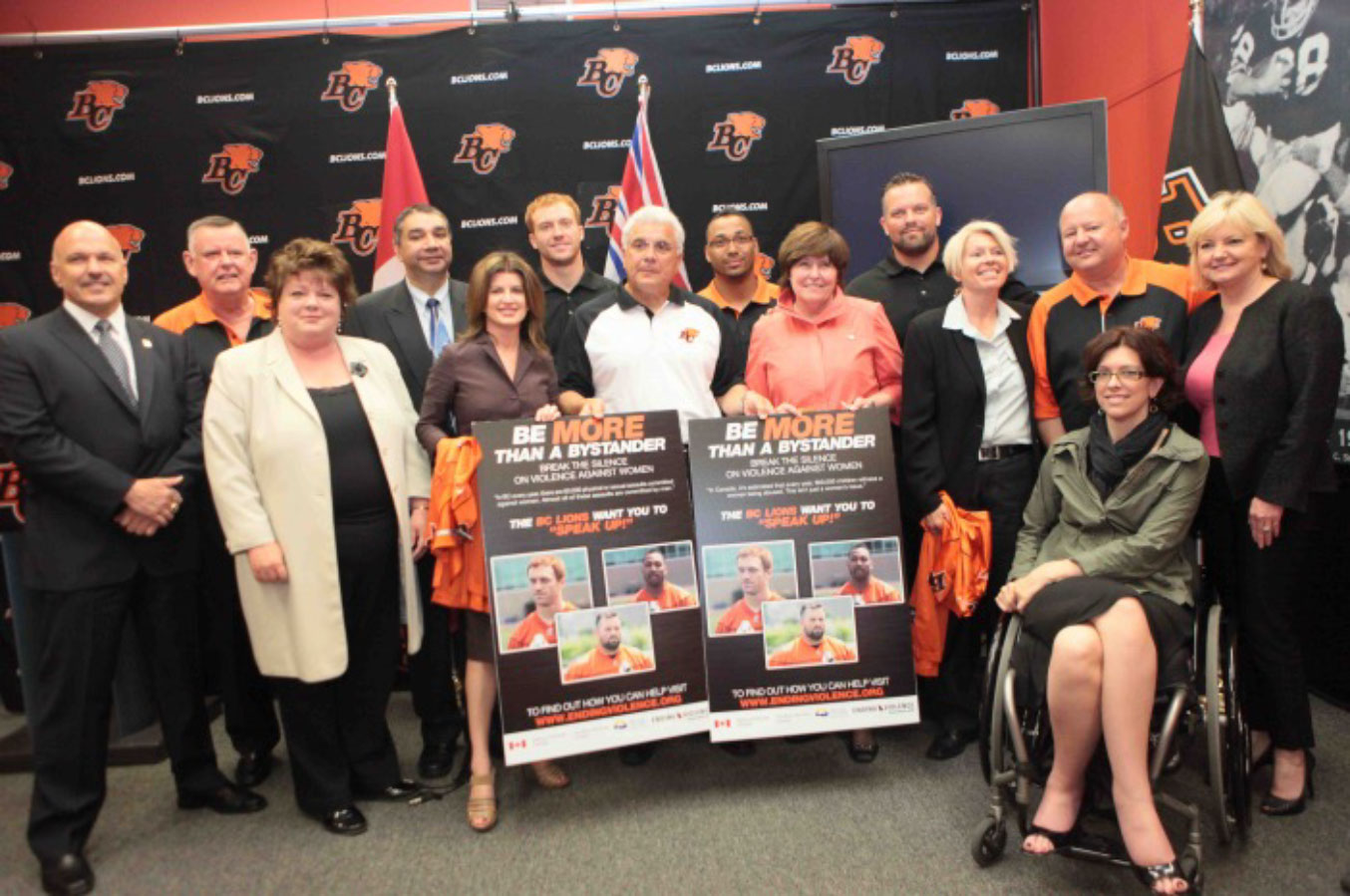
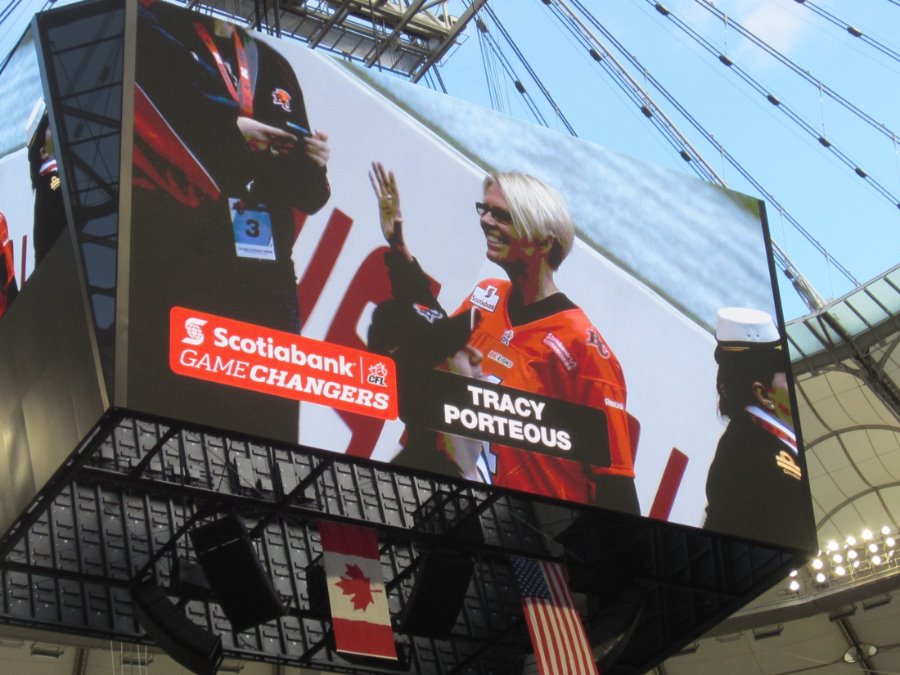
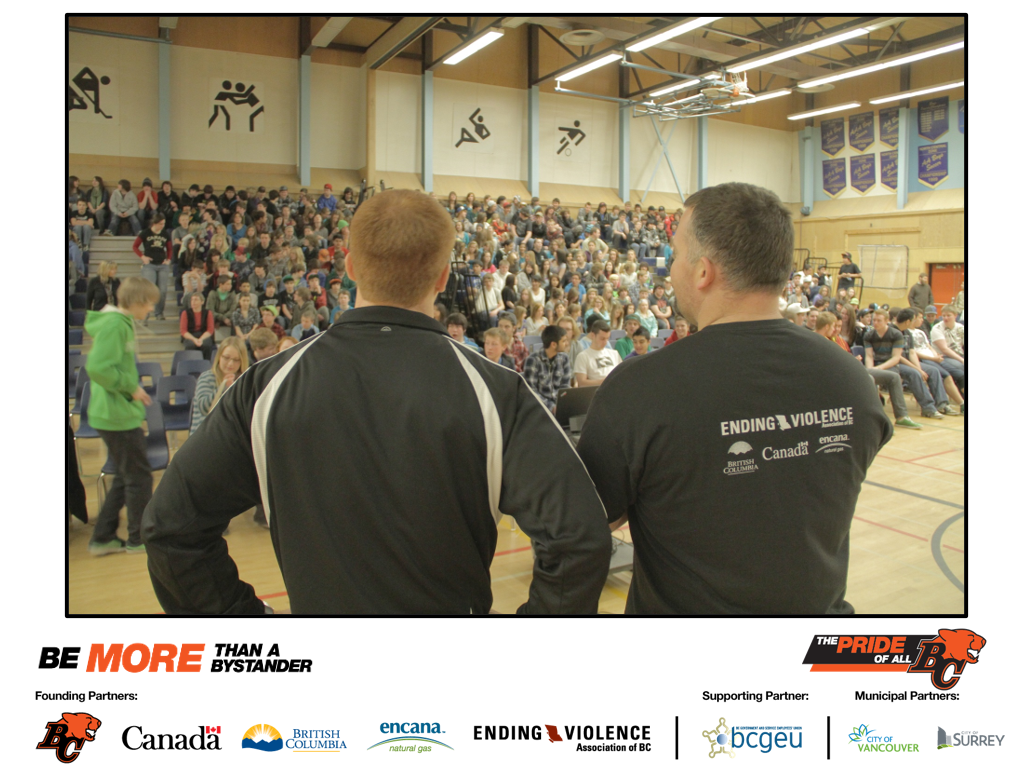
The decision would be an important part of what Be More Than a Bystander would come to represent. Leadership wasn’t simply about lending a name or logo to an issue. It meant being willing to examine your own culture and publicly say that this issue is everyone’s responsibility.
“For the BC Lions to align and stand next to EVA BC — it was a risky proposition”, says EVA BC’s executive director, Ninu Kang. “But their leadership at that time really believed this was a moral responsibility to the athletes and they made a commitment to zero violence against women and to position their players to inspire young boys to be different and to do better.”
The first goal was to “break the silence”
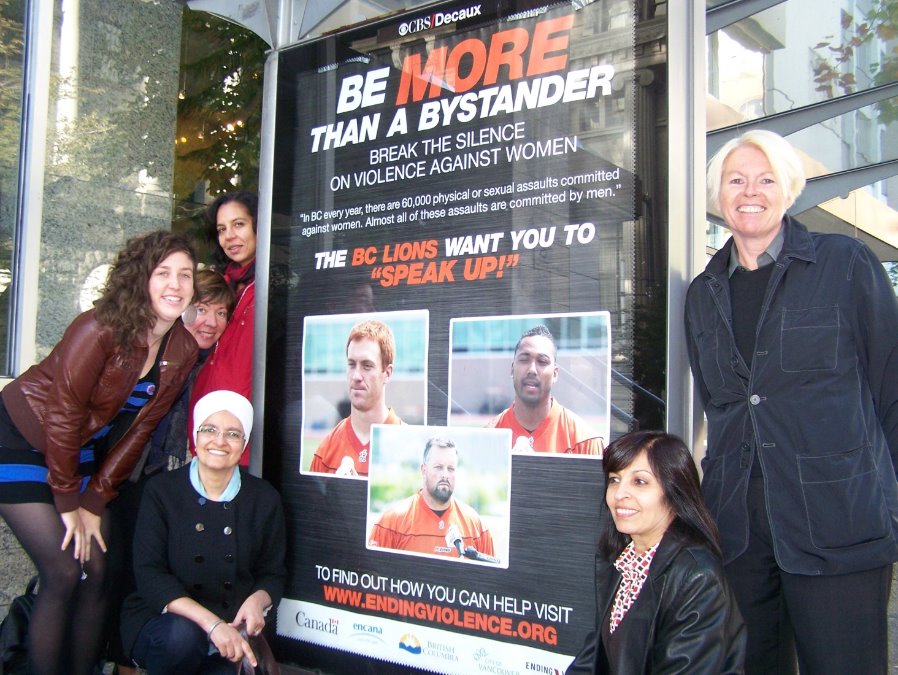
The original message of the program was: break the silence on violence against women.
“And that was the whole point,” says Jamie; “… because no one was talking about it.”
It was very powerful at the time.
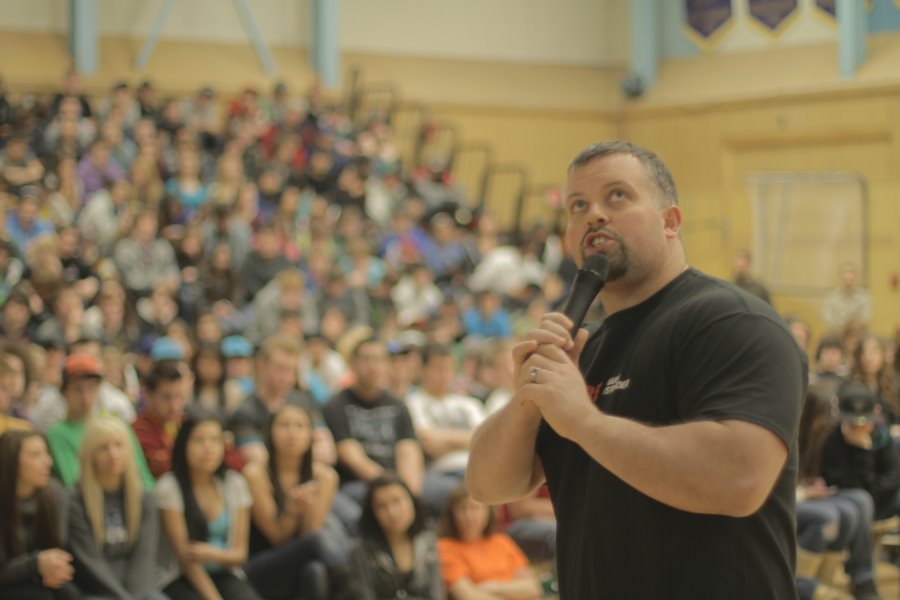
Today, conversations about gender-based violence, especially since the #MeToo movement are much more visible. But 15 years ago, professional football players standing in front of young students talking about this topic was significant.
Jamie remembers initially wondering whether the approach would work. Katz reassured him, saying “‘Jamie, you know, the very fact that you are prominent athletes in your community going out to speak on this subject, that’s enough. Because nobody else is doing it as it relates to men, no other men’s organizations are doing this.’”
The BC Lions Football club also participates in creating public service announcements (PSAs) and social media which create a greater reach than the presentations alone. “The social media campaign was massive,” says Jamie. “The players were not just speaking to children in the auditoriums.”
The high school program expanded across the province, and it didn’t just stay in the schools.
And that became the next marker for success.
BMTB became a model for success
With the early success of the program, workplaces started calling and asking: Could this work here too?
Jamie recalls an important shift when the Canadian Football League (CFL) took the program and then adopted a gender-based violence policy and harassment policy, with gender-based violence training it continues to require every CFL employee and team player to take each year. “That was a huge victory for EVA BC to get out the message around gender-based violence and to change the culture. We still have issues, but we deal with them: we have policies in place, we have partners like EVA BC who we can lean on for help when things come up.”
The program received awards early on including being profiled and highlighted by the United Nations at the Commission on the Status of Women (CSW) global session in New York City. [1, 2, 3]
But the most significant measure of success wasn’t the awards it was where the model went next.
The message changed because the conversation changed
Fifteen years ago, Be More Than a Bystander was asking people to break the silence. But today, simply talking about gender-based violence isn’t enough.
The next question is: What do we do with that awareness?
“That’s really where the program has continued to evolve,” says Ashley Humphrys, Manager of Social Enterprise at EVA BC. “We’re constantly asking how we can help people recognize harm earlier and, just as importantly, give them practical ways to respond. Awareness matters, but people also need to feel like they have options for what they can actually do in the moment.”
These are the questions that continue to shape the program.
There is no single perfect way to be more than a bystander.
What does success look like after 15 years?
Looking back, we can see now that the program was visionary. “Now lots of people are talking about educating men and boys,” says Jamie. In contrast with 15 years ago, Jamie notes “it’s certainly a part of the narrative now: I think the silence has definitely been broken, right? And I think our mindset as a society is changing, as it relates to gender-based violence. I hope it is anyways.”
And the BC Lions see only a plus with continuing with the partnership. “It’s brought nothing but goodwill to our organization, from our fans, from the general public,” says Jamie. “We’re really proud of that.”
Part of that future continues to involve bringing men and boys into conversation about gender, violence and expectations placed on them.
“The whole nature of the male persona in our society actually works against them and they don’t have these spaces to come together and learn and reflect,” says Ninu. “The Bystander training gives them more introspection and a better understanding of male culture. And they get the message that ‘I don’t have to hold all this on my shoulders’.”
For EVA BC, the next fifteen years means continuing to move beyond awareness alone, focusing on leadership and organizational culture change.
Watch for more stories from us looking at the action, growth and success of the Bystander program throughout the month of October.