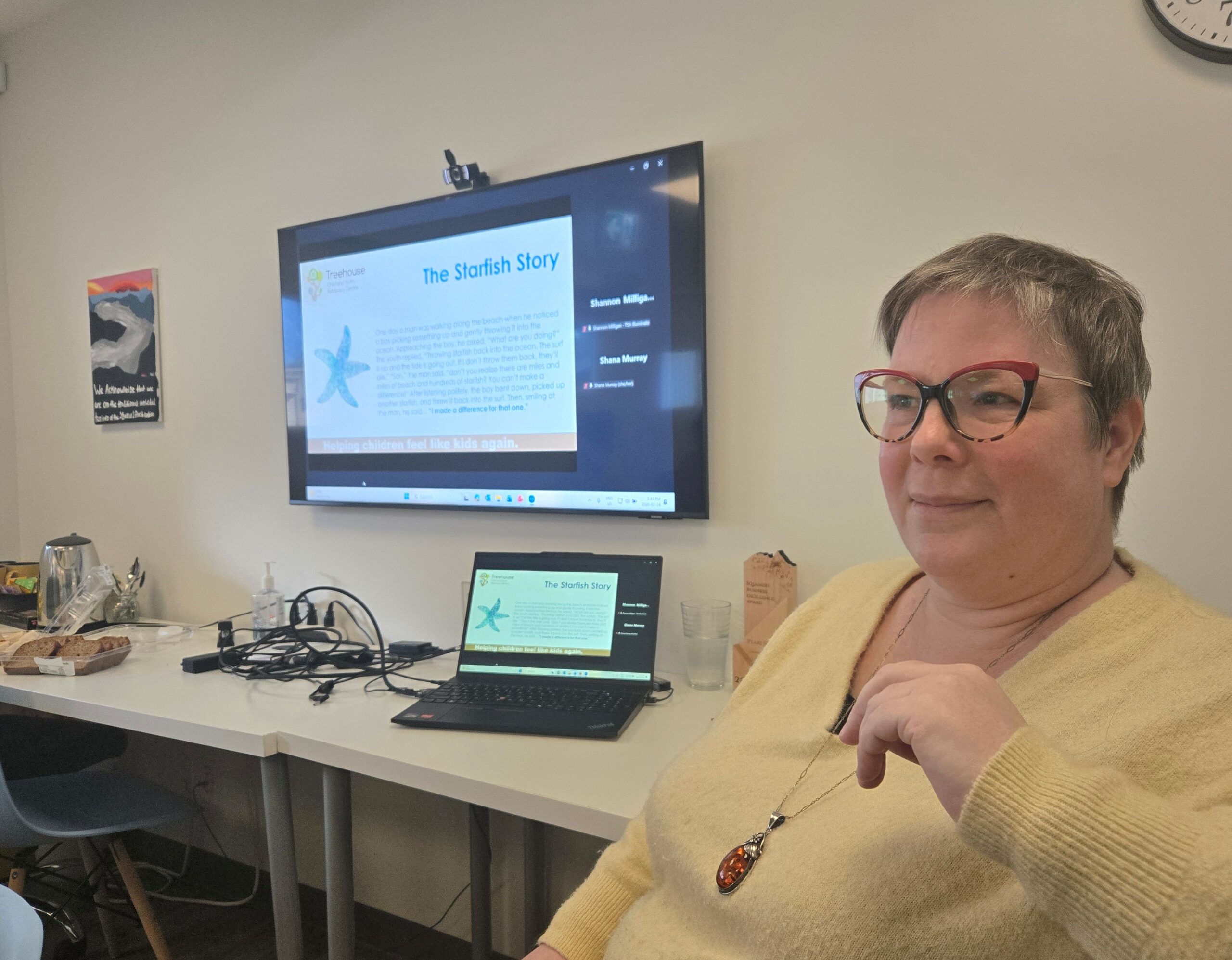
For Shannon Cooley, Sexual Assault Response and Prevention Coordinator at PearlSpace and facilitator of the Sea-to-Sky Sexual Assault Response Coordination Committee, the work to support sexual assault response in her community has been an almost 30-year journey in the gender-based violence sector.
“I was born and raised here. And I’ve always had an interest in anti-violence work, advancing feminist ideals and embracing intersectionality, and reconciliation as well.”
She can trace the seeds of coordination in her community to 2006 when the executive director of the Howe Sound Women’s Centre, Melany Crowston, co-founded the Sea-to-Sky Women’s Safety Network with Sheila Sherkat, the manager of the victim services program for the Whistler RCMP Detachment.
In 2008, Shannon joined the Howe Sound Women’s Centre (now PearlSpace) and the Sea-to-Sky Women’s Safety Network. She recalls that, of all the issues they considered, developing a local sexual assault response was the first and most important one to tackle. Because of the lack of stable core government funding for specialized anti-violence programs at the time, survivors had no easy access to forensic services or comprehensive victim support without a police file. A survivor of a sexual assault who wanted a forensic exam, whether they were in Squamish or Indigenous communities in the northern part of the region, had to travel down to Vancouver to access the program at Vancouver General Hospital.
“And sometimes, if they didn’t have transportation, that trip would be in the back of a police car,” she said. “Collectively, we felt this was not right.”
Sexual assault is more prevalent in rural and remote communities because of geographic and social isolation, limited access to transportation and cell phone coverage, and a lack of services for survivors.
For Whistler in particular, the seasonal influx of visitors to the area in the ski season and summer can also increase risk.
The lead up to the 2010 Winter Olympics really galvanized their coordination efforts. “We knew sexual violence could increase significantly over the Olympics,” Shannon said.
At the time, PearlSpace, together with other anti-violence organizations up and down the Sea-to-Sky Corridor, including Indigenous communities and in partnership with anti-violence organizations in Vancouver, worked together to coordinate a sexual assault response to the coming Olympic games.
“We started developing relationships across sectors to advocate to the Province and Vancouver Coastal Health for a more fulsome victim service response,” said Shannon.
A collaborative response to sexual assault is one that focuses on coordinating immediate interventions in response to disclosures of sexual assault to support survivors and improve their overall experience and outcomes within the medical and legal systems.
The journey to bring sexual assault forensic services to the Sea-to-Sky Corridor
Sexual assault forensic services are delivered by specially trained medical professionals, often forensic nurses, who provide sexual assault examination, emotional support, medical care and collection of forensic samples for survivors. This is distinct from community-based sexual assault support provided by frontline organizations like PearlSpace.
n 2011, the Woman Abuse Response Program and the Sexual Assault Services (SAS) at BC Women’s Hospital & Health Centre held a National Health Conference called For Her Own Good, with a stated goal to explore how social and health care systems and services that are designed for a woman’s “own good” may actually further harm or marginalize women when they try to access support.
Shannon co-presented with Sheila Sherkat of RCMP Victim Services in Whistler and Chair of the Sea-to-Sky Women’s Safety Network. Their presentation “Virtually without service: Systemic perils for survivors of sexual assault in the Sea-to-Sky Corridor” highlighted the lack of forensic services and other supports for survivors in the Corridor.
Their presentation was well-received, and when it ended, a representative from the Vancouver Coastal Health Authority (VCHA) stood up and announced that forensic services were coming to the Sea-to-Sky Corridor.
“You hardly ever get these tangible wins,” said Shannon. “We were super excited about that. But then nothing happened [for a few years].”
In 2015, Shannon was hired as the PearlSpace Sexual Assault Response and Prevention (SARP) Program Coordinator and Advocate and was able to focus fully on building comprehensive services for survivors of sexualized violence.
During the 2015 federal election, Canadian Press reporter Laura Kane’s story featuring an interview with Shannon about the lack of forensic services for women in the Sea-to-Sky Corridor made national headlines.
Within 48 hours of the story’s publication, the Province of BC announced that VCHA would be offering forensic nursing services to the Sea-to-Sky Corridor.
“Basically, it was Christmas Eve in 2015 when forensic [services] finally arrived in the corridor,” Shannon said.
“It actually took the CBC circling back in 2017 to tell the story of the limited services and then forensic [services] were moved all the way up the corridor,” said Shannon. “First to Whistler, and then eventually to Pemberton.”
The role of the Sea-to-Sky Sexual Assault Response Committee
By 2016, the Sea-to-Sky Sexual Assault Response Committee (SARC) was formed to address sexual violence in the region. The goal of the SARC is to support a collaborative community sexual assault response through education, prevention initiatives, trauma-informed, victim-centred and inclusive practices and reducing service gap barriers.
Shannon explains that the Committee thinks about “How do we bridge our working practices and language so we can actually create some positive change? We’ve recently heard from the Public Health Office that we have one of the best relationships in health and community social services collaborating for sexual assault response.”
The Committee is made up of members from across sectors — 71 community partners who have contact with sexual assault survivors like police, healthcare, and justice services, but they also invite guests to join their meetings, including survivors. Between 20 to 45 people attend every quarterly SARC meeting.
Shannon’s role of advocate and coordinator became permanently funded through the provincial government Sexual Assault Service (SAS) Program as of 2023, rather than through grants and funds from PearlSpace’s thrift store, Pearl’s Value and Vintage. The stable SAS Program funding now supports her role as the SARC facilitator.
Positive outcomes from PearlSpace’s advocacy and the SARC’s coordination efforts:
- There are now eight government-funded team members in the PearlSpace SAS Program based in Pemberton, Whistler and Squamish.
- Since 2015, representatives from the Sḵwxwú7mesh Nation, N’Quat’qua Nation and the First Nations Health Authority participate regularly in the Sea-to-Sky SARC, with the Lil’wat Nation sometimes being involved. PearlSpace’s SAS Program outreach worker works with First Nations north of Pemberton and is growing their role in a way that’s responsive to Indigenous communities.
- Survivors can now get access to forensic services from nine forensic nurses across the Sea-to-Sky Corridor 24/7.
- Consent and gender-based violence prevention education is offered to schools and the hospitality sector.
- Training on trauma-informed practice from Dr. Lori Haskell, a nationally recognized expert in trauma and abuse, was delivered to service providers in the Corridor. “Dr. Haskell really helped the police forces here have light bulb moments about how to change policing practices.”
- In March 2020, the SARC held a multi-sector training forum called CrossHatch at the Squamish-Lil’wat Cultural Centre for community partners from across the Corridor. Experts in various areas of sexual assault response best practices delivered two days of training that included guidance on navigating the justice system and “pathways to healing”.
- Special Victims Units in Squamish and Whistler have dedicated RCMP officers who work with survivors of intimate partner violence, gender-based violence or sexual assault.
- The local Sea-to-Sky RCMP have established a set of guidelines, reviewed by Crown Counsel, for how Sexual Assault Support workers can provide emotional support during RCMP interviews with survivors. “We had to do a little bit of advocacy around that, but it has come to fruition because we are recognized as professional victim service workers who can be trusted not to influence survivors in the interview room,” said Shannon. “We understand our role and can maintain and meet professional expectations.”
Get more information about Sexual Assault Coordination, training and EVA BC’S Coordination Communities of Practice (CoPs).