Our commitment to reconciliation
We stand for Truth and Reconciliation and commit to addressing the Calls to Action made by the Truth and Reconciliation Commission of Canada. We support and advocate for the Calls for Justice from the final report of the National Inquiry into Missing and Murdered Indigenous Women and Girls.
From ReachOut newsletter March 2026
Calls to ActionEmpty heading
BC’s first Indigenous Diversion Centre: a milestone achievement in Indigenous-led justice reform
A recent Statistics Canada report highlights the significant overrepresentation of Indigenous adults in provincial and federal custody in Prince Edward Island, Nova Scotia, Ontario, Saskatchewan, Alberta and British Columbia. Thirty-three point two percent of the adult custodial population are Indigenous despite the fact that Indigenous people represent only 4.3 percent of the overall adult population in these provinces.
In response to the report findings, Kory Wilson, chair of the BC First Nations Justice Council stated, “The numbers in this report are staggering, but not surprising. Indigenous people are not inherently more criminal — we are more criminalized.”
Unfortunately, the over-incarceration of Indigenous women is disproportionately higher. Forty-nine percent of female admissions to federal custody were Indigenous women whereas 32 percent of male admissions were Indigenous men. In BC, the population of Indigenous women in custody is growing — in 2023, 49 percent of women in provincial custody in BC were Indigenous, compared to 41 percent in 2013.
The criminalization of Indigenous women
“The over-criminalization of Indigenous women is largely a result of colonialism … Poverty, food insecurity, mental health issues, addiction, and violence, all parts of Canada’s past and present colonial legacy, are systemic factors that lead to the incarceration of Indigenous women.” National Inquiry into Missing and Murdered Indigenous Women and Girls, 2019.
Indigenous women are charged, prosecuted, convicted and imprisoned as a result of the systemic failures of the criminal legal and prison systems to recognize, contextualize or address the inequities, racism, sexism, violence and trauma they experience.
The majority of incarcerated Indigenous women have a history of domestic physical or sexual abuse, experienced physical or sexual violence, are residential school survivors or have family members who are residential school survivors, or went through the child welfare and youth detention systems.
Most crimes Indigenous women are charged for are non-violent and are committed to meet their basic survival needs — property and drug offences such as theft, fraud, trafficking of stolen goods. The violent crimes that Indigenous women are charged and convicted for are most often “defensive or reactive to violence directed at themselves, their children, or a third party.”
Diversion supports healing, safety and equity
The BC First Nations Justice Council’s (BCFNJC’s) Indigenous Diversion Centre (IDC) is the first of its kind in Canada. The IDC, located on Lheidli T’enneh territory (Prince George), hosts an innovative pilot program that will divert Indigenous people from criminal justice system involvement.
The presumption of diversion requires considering and applying culturally appropriate and least restrictive approaches at every point in time of an individual’s journey through the justice system, with the presumption that, whenever appropriate, these alternative responses should be the first option pursued.
The IDC aims to help break harmful cycles of reoffending, decrease Indigenous representation in jails (See Call to Action #30), and offer pathways to accountability, healing and culturally appropriate supports and resources. The IDC houses a trauma-informed multidisciplinary team of dedicated professionals who support IDC participants with long-term wrap around support. Participants can join ceremony, attend land-based and Elder teachings, learn skills in ‘Atsoo’s Kitchen (grandmother’s kitchen), and access services such as social work support and clinical counselling.
With financial support offered through Public Safety Canada’s Northern and Indigenous Crime Prevention Fund (NICPF), pre-charge and post-release programming is available to First Nations, Métis, and Inuit adults living in Prince George.
The pre-charge program diverts Indigenous people from being charged with eligible non-violent offences to the IDC (e.g., shoplifting, fraud or mischief), where they commit to following an individualized 90-day diversion plan to have their charges dropped. The pre-charge program focuses on the root causes of offending by providing a caring and cultural environment where healing can occur, intervening early to prevent reoffending and offering participants with an alternative path.
“People often think it’s a get out of jail free card, but in fact it’s much harder to face a group of your Elders, and to face your victim and the people that you’ve wronged and harmed and to take ownership over that,” said Wilson.
The post-release program supports Indigenous individuals after their release from provincial or federal custody to reintegrate into community.
Lheldi T’enneh Elder Marcel Gagnon, the IDC’s Elder-in-residence, shared, “Hopefully when they come and work with us, with the social workers, clinical counsellors, all these talented people we have here to assist them in housing and all those basic needs, I think it’s going to be very successful. Especially reconnecting with ceremony and being on the land.”
For more information on the Indigenous Diversion Centre, visit BCFNJC’s site.
Calls for Justice
Indigenous community-based solutions for gender-based violence
Indigenous community organizations like Carrier Sekani Family Services (CSFS) play a vital role in preventing gender-based violence against Indigenous women, girls and 2SLGBTQQIA people.
The CSFS Calls for Justice Program supports the implementation of the 231 Calls for Justice from the National Inquiry into Missing and Murdered Indigenous Women and Girls (MMIWG). The program works to create safer spaces and communities by raising awareness of the root causes and impacts of violence through community events, workshops, and advocacy initiatives.
Elder support and guidance are integral to the program, honouring Indigenous knowledge systems and cultural practices as pathways to healing. Veronica Campbell, Justice and Youth Advocacy Manager, talks about the importance of empowering communities: “Indigenous people have been here long before and will be here long after — they are the experts in their own lives. They’re the historical knowledge keepers of what works and what doesn’t. They know their land, they know the waterways and they know their practices.”
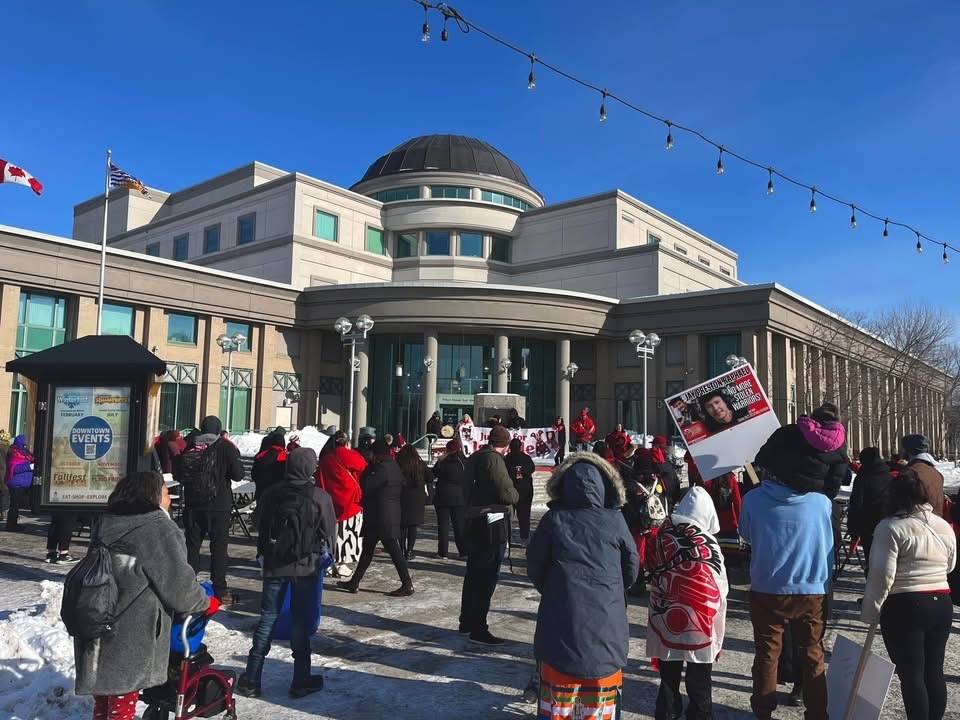
On February 14, CSFS held the 35th Annual Women’s Memorial March in Prince George to commemorate the lives lost through violence towards Indigenous MMIWG2S+ people, bringing together community members to share memories of the injustices they’ve endured and find comfort in each other. Kelsey Spears, Calls for Justice Outreach Worker, explains: “Supporting through awareness walks and events with families that have gone through tragedies are a really good way to [build] relationships, and connect people [to resources and each other] in different communities along the Highway of Tears. We’re empowering them to make decisions for themselves while also providing spaces that are safe, brave, and whatever else that people [need] to be able to express what they’ve gone through and help families to not have to face the same [pain and grief alone].”
Preventing violence through strength and wellness
The Strong Women Strong Community Program is a Calls for Justice Program prevention initiative that consists of a series of community workshops that uplift the wellness of Indigenous women, girls and 2SLGBTQQIA+ people.
This initiative encourages participants to build healthy relationships, trust their instincts, develop leadership skills and advocate for themselves and each other by fostering safety awareness, self-confidence, boundary-setting skill development, cultural pride, and self-love.
Kelsey describes why preventing violence is rooted in culture and collective strength: “[When] we create spaces where [culture] is not only encouraged but celebrated, people are seen and they are heard and feel connected not only to each other, but to the things that they and their ancestors have been connected to since the beginning of time.”
Kelsey shares, “We’ve been going out into communities, bringing together a number of services that support the five pillars of health — physical, mental, emotional, social, and spiritual [well being]. [This ensures that] women have those supports, those connections, to promote health and wellness so that we don’t see women getting to these points of crisis where they are experiencing violence and its negative impacts.”
Calls for Justice for all Canadians
Emily MacLise, the Calls for Justice Policy Advocate shares: “We all have a responsibility to be part of the solution and to contribute to preventing further violence against Indigenous women, girls, and 2SLGBTQQIA plus people. I think a lot of people are not aware that there are calls directed to all Canadians … would really encourage people to go read [them] (See Calls for Justice 15.1 to 15.8) and think about how they can contribute to ending violence against indigenous women, girls, and 2S plus people by creating safe spaces, but also taking on the work to challenge the colonial ideologies and racism that still persist in our society and that are often used to justify this ongoing violence towards Indigenous peoples and Indigenous communities.”
Kelsey adds, “There is power in numbers and there is so much power in showing up. These advocacy walks and events and gatherings matter. When people see you at them, it matters. You will become a safe space to people.”
Kelsey continues, “A lot can be said about sharing a post and making your stance in your opinion on gender-based violence and violence against anybody, Indigenous women, girls, and 2SLGBTQQIA peoples. It’s a world right now where everyone is, I think, quite afraid to say where they stand. And it’s just so, so important for the person sitting next to you or walking across [from] you on the street to know that you are safe and you care.”
For more information, visit highwayoftears.org to find details about the upcoming 20th Anniversary Highway of Tears Symposium, and the film series Stories of Hope and Strength which was created in response to Calls for Justice 6.1.iv.