Calls to Action
Transforming the child welfare system to end violence against Indigenous children, women, girls and 2SLGBTQQIA+ people
Because of the ongoing discrimination and significant harms that Canada’s child welfare system perpetuates against Indigenous children and families, child welfare advocates and Indigenous leaders refer to it as the “modern-day residential school system.” The stark evidence that backs up their assessment is clear — there are more Indigenous children in the child welfare system now than there were at the height of the residential school system. In 2021, 54% of children in foster care in Canada were Indigenous even though Indigenous children made up 7.7% of the child population. Indigenous children are 17 times more likely to be removed from their families and placed out-of-home than non-Indigenous children.
Indigenous children who end up in the care of government are at a greater risk of harm because of their historical and ongoing displacement from their traditional homelands and disconnection from their culture and languages. “We need to understand that these children often have traumatic experiences before they come into care but then often in the care system, because it is so under resourced, those kids have additional traumas, which predisposes them to other types of risk,” said Dr. Cindy Blackstock, Executive Director of the First Nations Child and Family Caring Society.
In its 2023 report, the Representative for Children and Youth (RCY) found that 65% of young people reported lost or missing in BC were Indigenous; Indigenous females were over-represented among the lost or missing. For many children and youth, there was a pattern of ineffective services that failed to meet their needs and violated their rights to adequate care, protection and to be heard. The report linked the sense of “unbelonging” experienced by children in the child welfare system to a greater risk of substance use, mental health crisis, violence and sexual exploitation.
The link between the child welfare system and violence against Indigenous women, girls and 2SLGBTQQIA+ people
“Child welfare is one of the primary structural drivers of violence against Indigenous women, and we have to be bold enough to say that,” says Joni Conlon, Executive Director of Our Children Our Way Secretariat. “The system itself can be seen as an act of violence against Indigenous women.”
Government child welfare policies are historically rooted in colonial, racist philosophies aimed at dismantling Indigenous relationships, families, and communities. The mass apprehension of Indigenous children during the “Sixties Scoop” was based on assumptions about Indigenous women being unfit mothers — including those who were seeking help in fleeing violence. The findings of the National Inquiry into Missing and Murdered Indigenous Women and Girls, the reports produced by the Truth and Reconciliation Commission of Canada, and the implementation of United Nations Declaration on the Rights of Indigenous Peoples all point to a connection between the Missing and Murdered Women, Girls and 2SLGBTQQIA crisis and the child welfare response.
The trauma experienced by Indigenous children from the residential school system and the Sixties Scoop has left generations of Indigenous children without parenting models and the long-lasting psychological impacts of abuse.
The devastating impacts of the historic and ongoing separation of Indigenous children from their families is reflected in the disproportionate amount of violence experienced by Indigenous women. A recent Statistics Canada study found that:
- Indigenous women were more likely than non-Indigenous women to experience childhood physical or sexual abuse by an adult during childhood and to have experienced harsh parenting.
- 81% of Indigenous women who had been in the child-welfare system had been physically or sexually assaulted over their lifetime.
The removal of children by child welfare services is associated with negative health outcomes for parents, including poor mental health (e.g., suicidality, depression, and anxiety), substance use, and premature mortality. Recent research has identified a higher risk of harm for Indigenous women — a 2026 study found that the risk of mortality (i.e., from suicide, overdose) associated with child removal for First Nations mothers was more than four times higher than for non-First Nations mothers.
Our Children Our Way: leading system transformation through advocacy and cultural safety
The Indigenous Child and Family Services Directors (ICFSD) Our Children Our Way Society represents Indigenous Child and Family Services Agencies (ICFSAs) in British Columbia. ICFSAs were created to prevent the removal of children from their communities and provide culturally appropriate services (See Call to Action 1.ii). There are currently 24 First Nations, Inuit and Métis ICFSAs serving more than half of all Indigenous children and youth in care across the province.
Our Children Our Way (OCOW) Society supports Indigenous Nations’ visions for jurisdiction and self-government by providing a collective and expert voice on Indigenous child and family well-being matters. OCOW advocates for systemic changes to policy, practice, legislation, and funding to ensure the best interests of Indigenous children are being met. OCOW works collaboratively with federal and provincial governments to build and enhance child and family service delivery, including the implementation of the Calls for Justice 12.1 – 12.15.
“The over-representation of Indigenous children in care across Turtle Island is largely because of the systems that support [child welfare],” says Joni. “[The systems] come with an intervention lens. They do not come with that prevention lens of how we bolster and strengthen the family as opposed to penalizing, over-surveilling, and in essence, perpetuating violence against women. I think it is important to identify the systemic issue rather than blaming individuals.”
Joni continues, “Identity and belonging are at the heart of children’s well-being. Our responsibility is to remove the barriers created by colonial systems and ensure that families have what they need to stay connected to their homelands, cultures, and Nations. When communities are resourced to lead their own child and family well-being, families are stronger, children are safer, and future generations can thrive.”
A pivotal time in national child welfare reform: recent milestones
In 2007, Dr. Cindy Blackstock from the First Nations and Family Caring Society, along with the Assembly of First Nations, filed a complaint with the Canadian Human Rights Commission. They argued that the federal government funding for child welfare on reserves is much lower than provincial government support for children off reserves even though on-reserve needs are greater and contributes to the overrepresentation of Indigenous children in the child welfare system.
In 2016, the Canadian Human Rights Tribunal (Tribunal) ruled that Canada discriminates against First Nations children on reserves by failing to provide the same level of child welfare services that exist elsewhere. The Tribunal ordered the federal government to end discrimination and take measures to redress and prevent it, redesign the child welfare system and its funding model, and ensure First Nations are given culturally appropriate services.
In 2019, An Act Respecting First Nations, Inuit and Métis Children, Youth and Families became law. The Act affirmed the rights of Indigenous governments and organizations to exercise jurisdiction over their children and families and develop policies and laws based on their histories and cultures. The Act also created a set of National Standards that must apply when working with Indigenous children, youth and families. “[The Act] no longer was focused just simply on the physical safety of a child, but it really was about the spiritual, emotional, mental, and physical safety of a child, along with supporting culture, identity, belonging, familial connections and sibling solidarity,” says Joni.
Joni says, “This is a pivotal moment in our history. More Indigenous Nations now have pathways to exercise jurisdiction over child and family services and give effect to their own laws, traditions, and governance. That is not about creating something new — it is about restoring and recognizing what Indigenous Peoples have always known: our children thrive when they are raised within their families, cultures, languages, and Nations. Indigenous communities have always had the knowledge to care for their children. Our responsibility now is to ensure they have the recognition, resources, and support to fully exercise that authority.”
There are currently two plans before the Tribunal to end discrimination in the child welfare system: the Loving Justice Plan (LJP), submitted by the National Chiefs’ Children’s Committee (NCCC), and Canada’s National First Nations Child and Family Services Long-Term Reform Plan.
“The number of Indigenous children in care Is largely preventable,” says Joni. “There are things that we can do to support family well-being and women, who are often the primary caregivers of children. When women are supported with housing, culturally grounded services, community care, and family preservation, we reduce the conditions that create vulnerability and crisis. The plans address how we get upstream so that we can front load prevention services and break down barriers so that there’s access to more supports.”
The Tribunal will review the plans to determine whether, based on its 2016 ruling, they meet its orders; it may choose one plan or make orders based on a mixture of the two. This July, the Assembly of First Nations Chiefs in Assembly will meet and vote on the plans to determine which plan, or mixture of plans, they will support and move forward on.
For more information, visit Our Children Our Way.
Register for the 2026 Our Children Our Way National Conference: Amplifying Children and Youth Voices.
It’s been 20 years since Carrier Sekani Family Services (CSFS) together with Lheidli Tenneh hosted the first Highway of Tears Symposium in Prince George as a call to action and to bring attention to the many cases of missing and murdered Indigenous women and girls along the “Highway of Tears”: 725 km of mostly very isolated road on Highway 16 between the inland city of Prince George and Prince Rupert on the coast.
That 2006 symposium gained national and international attention for the Highway of Tears and for many families it was the first time that they shared their stories. It also produced a Highway of Tears Symposium Recommendations Report that identified the root causes of the violence, including the intergenerational trauma from colonial and patriarchal policies, and made 33 recommendations for what needs to change. Twenty years later, the highway continues to be unsafe and plagued by many of the same issues.
CSFS brought together Carrier Sekani Tribal Council, Lheidli T’enneh First Nation, the Prince George Native Friendship Centre and members of the former Highway of Tears governing body to hold the event framed by the theme: Where We Were, Where We Are and Where We’re Going.
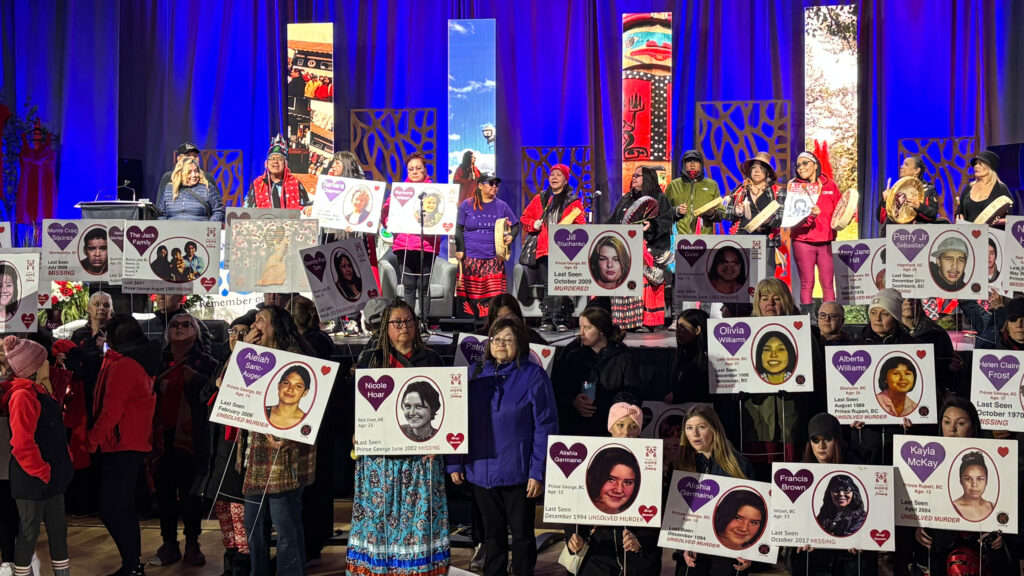 Families hold photos of their loved ones, the missing and murdered Indigenous women and girls at the 20th anniversary Highway of Tears Symposium.
Where we were: The recommendations
Two of the recommendations from the 2006 report were completed by CSFS: the creation of billboards along the highway to honour and raise awareness of the missing and murdered Indigenous women and girls (recommendation #9) and a prevention media campaign (recommendation #14).
CSFS is working now with new funding to create updated billboards that better reflect the territory and nations.
They also developed a series of videos, Stories of Hope and Strength, that emphasized the strengths of the women in the community instead of focusing on victimization.
Substantial gaps to safety remain for access to transportation along the highway and cell phone connectivity, with large sections of the highway where calls and texts do not go through and emergency phones have not been set up.
Where we are: The 2026 Symposium
Keynote from Mary Teegee-Gray
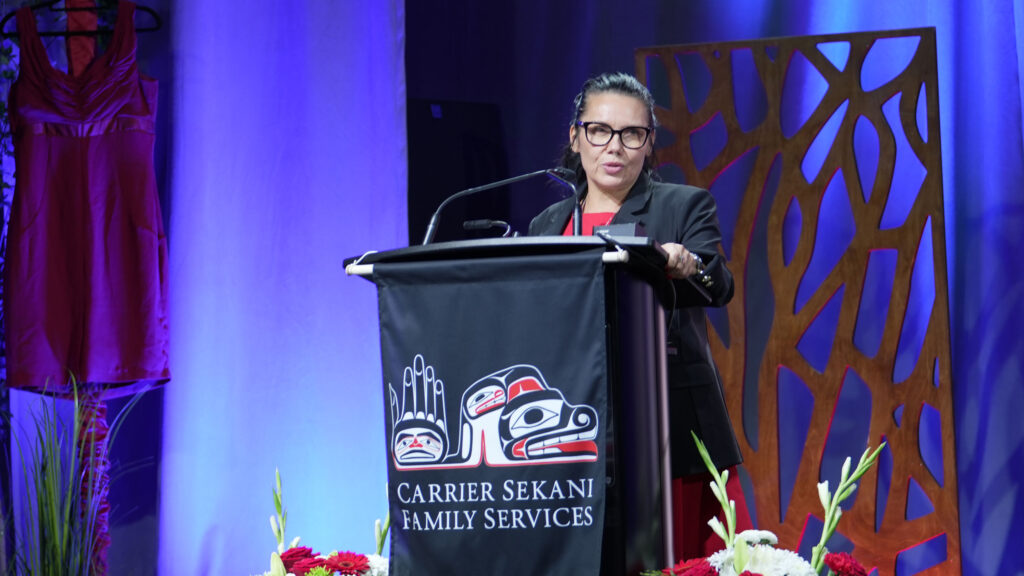
Mary Teegee-Gray, Chief Administration Officer, Child and Family Services at CSFS hosted the symposium and delivered her address How we got here on the morning of the first day.
Speaking of reconciliation, she said, “How can we reconcile a relationship that never was? The proper wording is to build the conciliatory relationship; and that’s what we’re doing here today with our government partners, RCMP and other stakeholders. You build it on trust, you build it on wisdom, you build it on respect, you build it on substantive equality, and you build it on love. That’s how you build a country.”
EVA BC’s executive director, Ninu Kang
EVA BC’s executive director, Ninu Kang, spoke on the first day as part of a panel, HERstory: Why are Indigenous Women Vulnerable?
“I was honoured to join the panel of experts,” said Ninu. “It was an incredible, thoughtful symposium with survivors and community and I was honoured to be part of that. I am committed to work alongside Indigenous women leaders to ensure that the recommendations are moved to action. One of my takeaways is to reconsider the language we use like ‘reconciliation’ as we move towards meaningful change and solutions.”
Youth Panel
The third day of the symposium included a Youth Led Panel with facilitator Samantha Cocker, BC’s Deputy Representative of Advocacy and First Nations, Métis and Inuit Relations for the Representative of Children and Youth, and four youth panelists — bridging the generation gap and including youth voices.
The young people shared their frustrations with wanting to get out of town but not being able to take the highway; what life looked like for them when the first Highway of Tears report was written, and how it’s shaped their lives.
Pillars of Hope and Strength
On day four of the symposium, attendees travelled to Cottonwood Island Park for a reveal of the Pillar of Hope, created for the occasion to honour the missing and murdered Indigenous women and girls. The pillar is made of four cedar panels with images that reflect different seasons, designed by local artist Clayton Gauthier, from the Nak’azdli Whut’en Nation and hand-painted by James Tasa and Wayne Ward. A matching pillar is planned for Prince Rupert — the Pillar of Strength — and will likely incorporate art from the local Tsimshian Nation.*
Where we’re going: What still needs to change
Backed by the strength and perseverance of the families, the CSFS Calls for Justice team commits to continue the fight to raise awareness, follow up on the information gathered from communities across Northern BC on what is needed to prevent further violence against Indigenous women and girls, have planned conversations with key ministries and continue efforts to update and implement the 2006 recommendations.
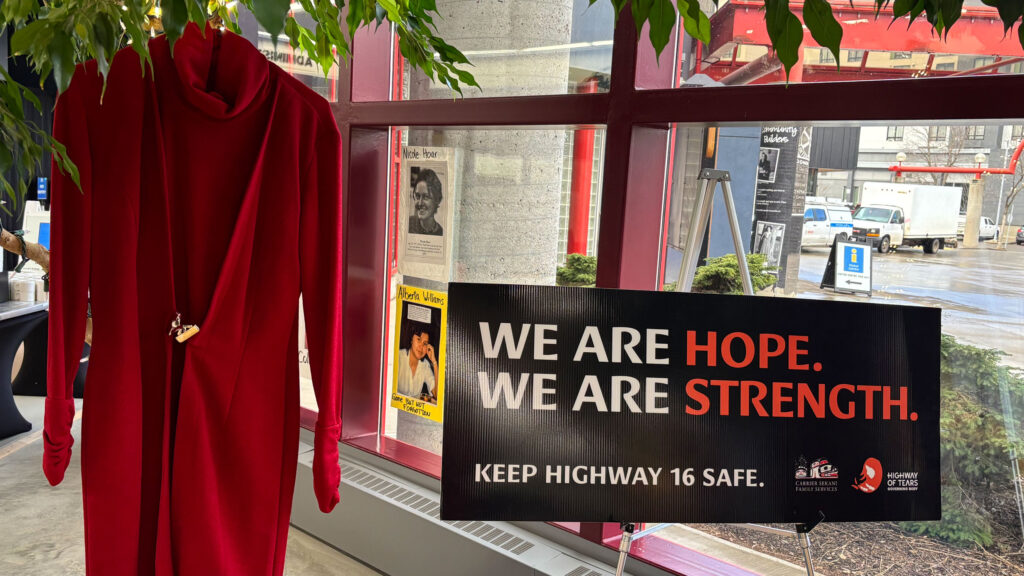
*You can hear more about the story of the Pillars of Hope and Strength, the first episode of the BC Society of Transition Houses (BCSTH)’s podcast.